For most students, the northern lights are something they’ve only seen online or in pictures: neon greens, purples, and pinks stretching across the sky like something out of a fantasy movie. Social media makes it look almost unreal, like the sky is exploding with color. But as many who finally see them in person discover, reality can be very different from expectations.
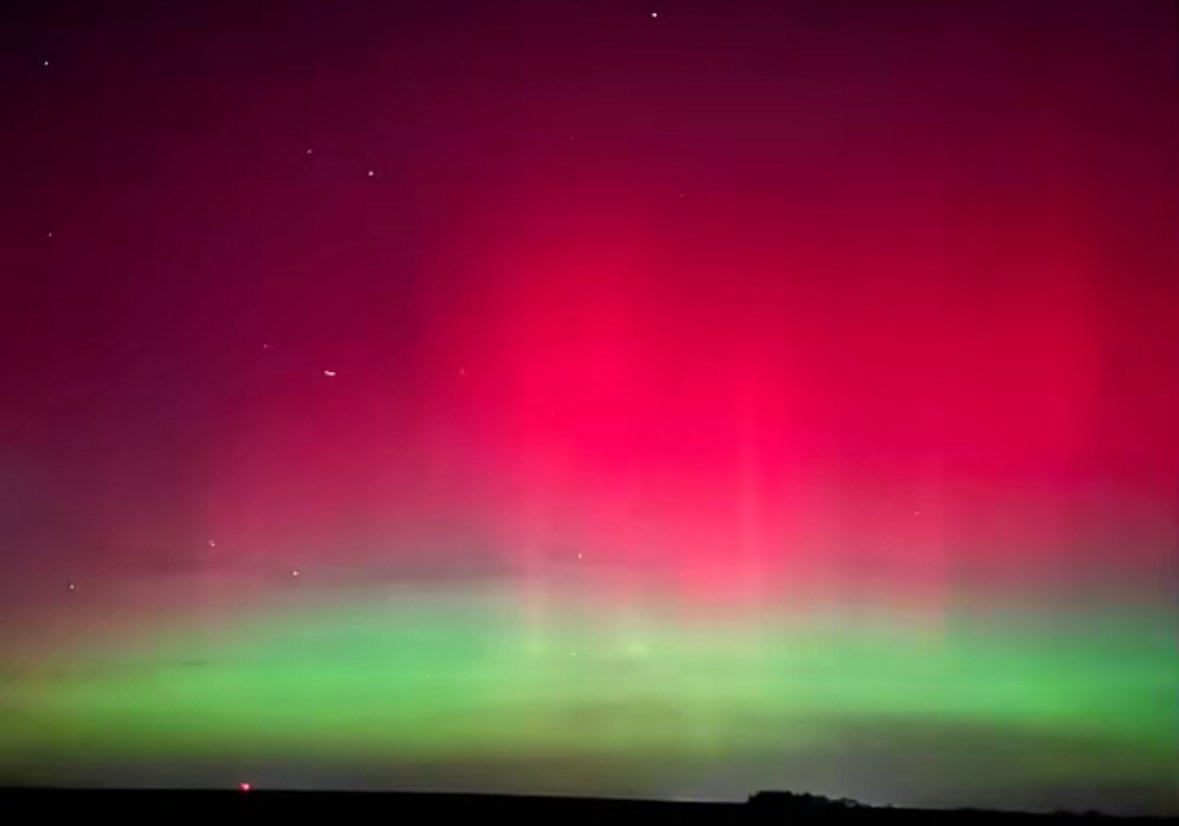
The difference between expectation and reality isn’t just about photo filigrees—its science. The northern lights, also called the aurora borealis, occur when charged particles from the sun—called the solar wind—interact with the earth’s magnetic field and atmosphere. When these particles collide with gases like oxygen and nitrogen, energy is released as light. Cameras, especially those using nighttime mode or long-exposure setting, capture more light than the human eye can see, which is why the aurora often looks brighter and more dramatic in pictures than in reality. In person, the colors are usually softer and the movements slower, creating a quieter, more peaceful experience.
Before seeing the aurora in person, both Ava Krebs (10) and Jaymie Evridge (11) had a clear picture in their minds of what it would look like. Ava Krebs (10) said she expected them to be “really easy and vibrant to see,” imagining bold colors that would light up the sky the moment she stepped outside.
Jaymie Evridge (11), who had only seen photographs online, expected the light to be “way brighter” than reality. Both students agreed that social media and edited images played a huge role in shaping their expectations. Videos and time-lapse photography often show the northern lights as glowing, dynamic ribbons that fill the entire sky. For students who have never witnessed them in person, that’s the image that sticks, and it’s hard to imagine anything else.
When the aurora finally appeared, the experience was different from imagined, but no less remarkable. Ava Krebs (10) describes them as “really bright and cool to see, but they weren’t as vibrant in person as they are when you take a photo of them.” She admitted that she has to take out her phone to really notice the colors, as the human eye doesn’t pick up as much light as a camera does. “You have to take out your phone to really see them,” she said. Despite this, she called the moment “a once in a lifetime experience” and said it was both beautiful and exciting. If she could go on a dream trip to see them again, she said she would go to Canada to get a clearer and more vibrant view.
Jaymie Evridge (11), seeing the northern lights for the first time, had a similar reaction. While the colors weren’t as bold as in the pictures, she said the experience was still magical. She described the aurora as “colorful fogs,” soft and subtle yet mesmerizing. “It was so exciting I was screaming,” she admitted. The moment made her reflect on how vast the world is and how small we feel in comparison. “Seeing them changed my perspective because I realized there ae so many bigger things in the world,” she said. Jaymie Evridge (11) dream trip to see them again would be a full adventure, a drive throughout Northern America, ending in Canada, hiking up the mountains and staying there with family and friends to watch the aurora from a quiet, natural setting.
For Ava Krebs (10) and Jaymie Evridge (11), the northern lights didn’t match their social-media-fueled expectations—but that didn’t make the experience any less meaningful. Ava reflected, “Even though it wasn’t exactly what I imagined, it was so beautiful. You can’t really understand it until you see it,” Jamie added, “It wasn’t neon and bright like I thought it would be, but it was magical in a way I never expected.” Their experiences show a bigger lesson for all of us. Expectations can prepare us, but in reality it has its own power. Sometimes, what’s real is more subtle, more personal, and more memorable than what they imagined. The northern lights may not always match what students see online, but for those who witness them firsthand, the moment is unforgettable, a quiet reminder of the beauty and vastness of the natural world, and how much there is still to explore.